The majority of industrial operations are dependent on water. Without an efficient water supply, it is not possible to maintain continuous operation. Machines are subjected to pressure and temperature; heat distribution is essential to prevent damage. Water is also used as a raw material in multiple processes, cleaning structures, waste treatment, etc. Thus, a consistent water supply is crucial to running a factory smoothly. Pumping systems will solve this problem as they are capable of moving high volumes of fluids across large distances against all resisting forces. Hence, choosing the right pumping system based on your factory requirements is necessary. This can be a conventional or a hydro-pneumatic water pumping system. Analyse the role of these pumps for your factory.
Understanding the features of hydro-pneumatic and conventional pumping systems
Hydro-pneumatic pumps
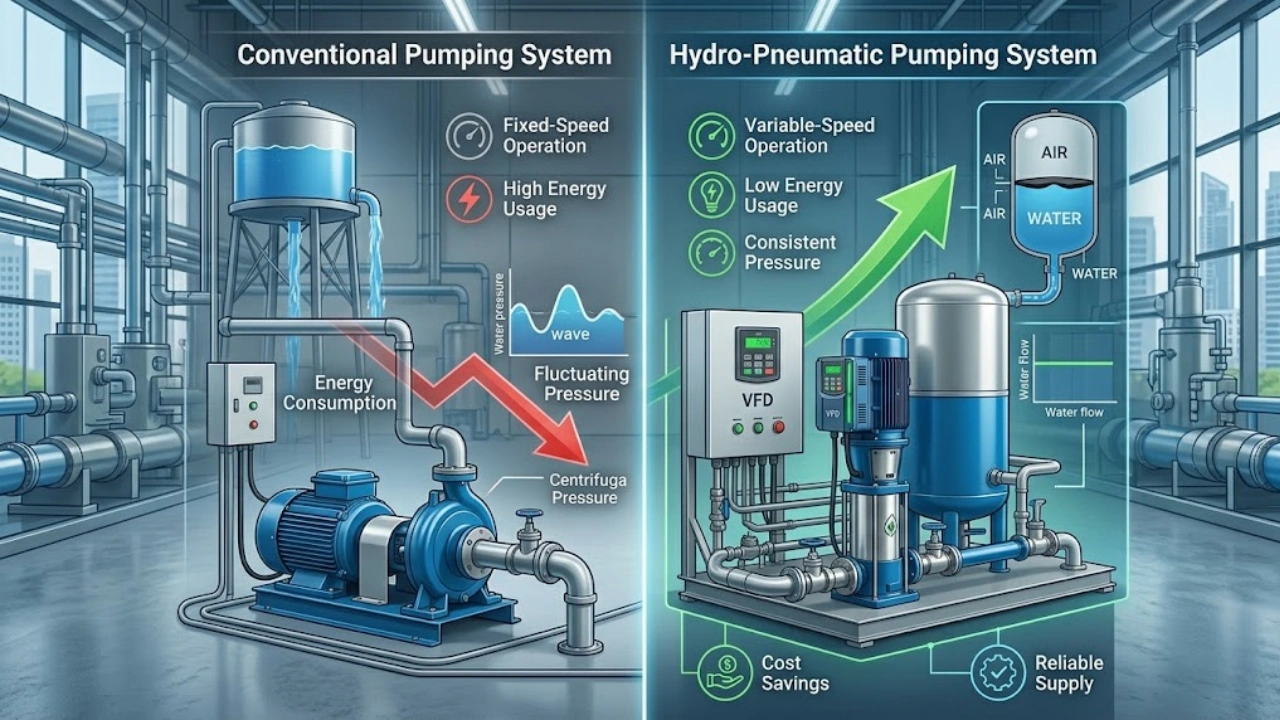
It is an advanced model that combines hydraulic and pneumatic technologies to ensure consistent water pressure in a system. The characteristic of these pumps is:
- Consistent performance: Water requirement varies; hence the pump does not always need to function. These are engineered to change their flow rate based on real-time demand. This will enable the residents to enjoy a constant water supply in their appliances.
- Pressure management: It performs within a set range.
- Automatic handling: Manual labour increases the chances of error. Machines requiring manual intervention always need someone to turn on/off the equipment according to pressure changes. Hydro-pneumatic pumps are automatic and have sensors that switch the system when pressure drops and shut down when demand is fulfilled.
- Control panel: It ensures alternation of the lead pumps so that each of them has the same running time.
- Tank: Corrosion occurs when water absorbs the trapped air. These tanks are built to separate water and absorbed air to prevent rust formation.
- Safety apparatus: The hydro-pneumatic water pumping system includes safety devices that prevent the pump from overheating by stopping its operation when there is a shortage of water supply in the line, and also restricts it from drawing too much electricity.
Conventional pumping systems
These have a simple design and operate at a fixed speed. The key characteristics are:
- Fixed-speed: The pumps operate at a constant speed, making it inconvenient for industries where demand keeps changing.
- Less energy-efficient: They are functional all the time, regardless of any requirements, hence they lead to greater energy usage and inflated electricity bills.
- Strong structural design: They are robust, easy to handle and are beneficial in small-scale businesses, agricultural practices, etc.
- Overhead tanks: The pressure depends on the height of the tanks. Thus, the flow becomes inconsistent in taps operating at high floors. The structural design needs to be strong enough to support the weight of the tanks.
- Fluctuating pressure: These pumps are unable to maintain a consistent pressure due to changing demands.
Ensure the best pumping system for your industry
The requirements of factorial operations are frequently changing; hence, it is difficult for conventional pumps to fulfil them. Hydro-pneumatic pumps are ideal for industries as they will ensure consistent performance. Hence, purchase from the leading pump manufacturers, Fluid Energy System Pvt Ltd, for the smooth functioning of your business.