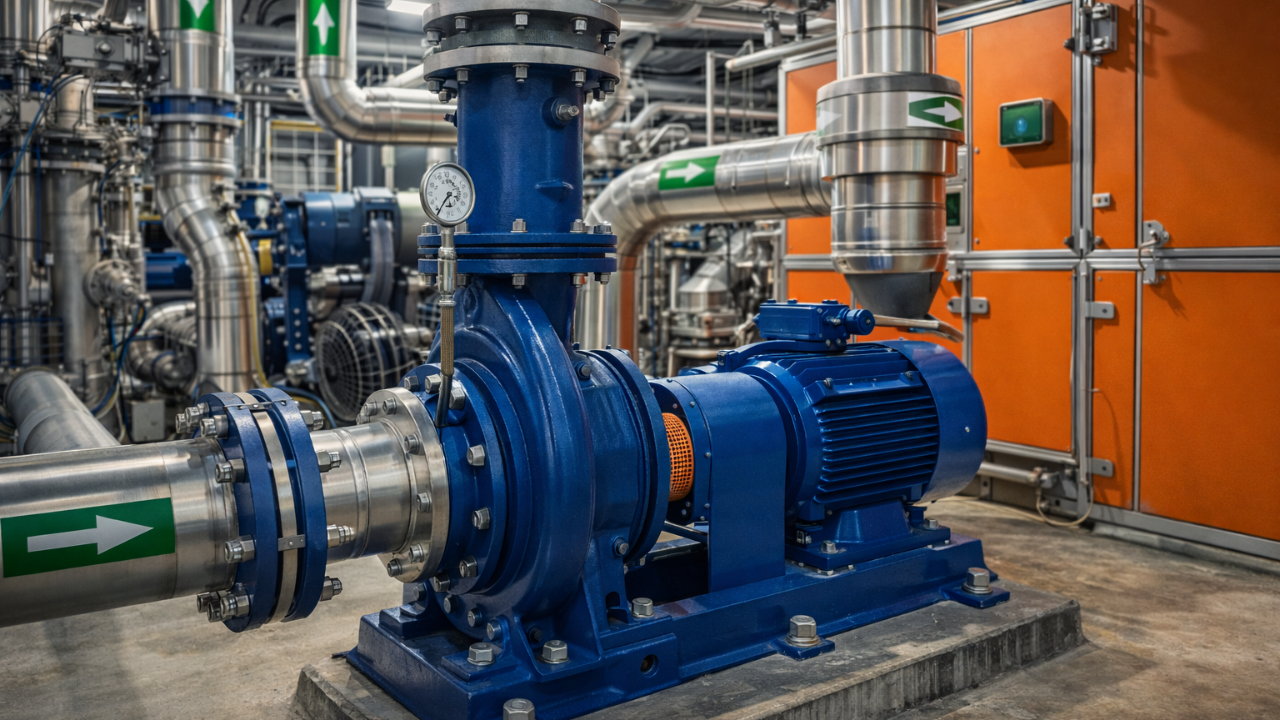
Machines are an integral part of any industry. They are required for manufacturing high-quality products at a quicker speed. Hence, they should be functioning at their peak capacity to fulfil the market demands. One of the best ways to keep them healthy is to maintain a cool environment. Overheating of machines reduces their operational efficacy and lifespan. This can also lead to workplace hazards. Incorporating a chilled water pump in factories is a great way to keep the atmosphere cool. They remove excess heat from the systems by circulating chilled water.
Mechanism of action of the chilled water pump in HVAC systems
-
- Loop: It works in a closed-loop system, which means water is carried from the chiller to the Air Handling Units.
- Driving force: The water entering the pump rotates in an impeller. This, in turn, uses centrifugal force to fling it out at high pressure.
- Types of Pumps: The most common varieties are base-mounted pumps and canned-motor lined pumps. These use Variable Frequency Drives, which means they can adjust their flow to the requirement.
- Systems: The two types of systems are primary and secondary. Primarily, water is circulated through the chiller and then secondary distributed through the buildings.
- Purpose: They maintain a steady flow rate and pressure so that each zones of the building get properly cooled.
The heated water from the AHU is returned for cooling in a constant process.
Top 5 chilled water pump issues
- Blockages: This is due to sediment or debris deposition. Even clean water has small sediments that get deposited over time and block the pump. The outdoor environment is prone to debris accumulation. One of the first symptoms of blockage is a decrease in flow rate.
Solution: Regular cleaning and flushing of the pump can remove the accumulated dirt. Filter installation is another way of trapping sediment.
- Decreased efficiency: The common symptoms to identify it are enhanced energy usage and inconsistent flow rate. This can be due to wear and tear of the components, or bubbles get trapped in the system. Often, the incorrect size of chilled water pumps also affects the operational efficiency.
Solution: Frequent inspection of components and check for any leakage.
- Rust formation: Water with high mineral content leads to corrosion. One should use pumps that are suitable for the mineral percentage of the water.
Solution: Testing the water ph, mineral level regularly will be of help, or you can install pumps made of rust-resistant materials such as stainless steel.
- Excess heating: This can be identified by frequent shutdowns of the machine or a burnt smell from the motor. It can be due to overburdening of work or inadequate wiring.
Solution: Use sensors that detect overheating and check wiring.
- Noise: When the components are not properly aligned or there is damage in the impeller, unusual sounds are heard.
Solution: Check if the parts are properly healthy and repair the components if damaged.
Maintain a cool atmosphere in the residential buildings
Heat management in HVAC systems is essential as it ensures the safety of people and energy-efficient systems; hence, chilled water pump installation is crucial. Approach the leading pump manufacturer, Fluid Energy System Pvt Ltd, to ensure high-grade products.